About
Legendary Pakistani vocalist who carried a 600-year-old Sufi qawwali tradition from the shrines of Punjab to the world’s biggest stages.
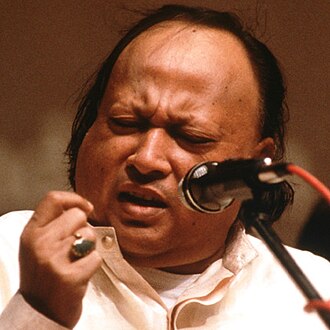
Ustad Nusrat Fateh Ali Khan (1948–1997) was the greatest qawwali singer of the modern era — a voice so powerful it carried a 600-year-old Sufi tradition from the shrines of Punjab to the world’s biggest stages.
Early life
Born on 13 October 1948 in Faisalabad (then Lyallpur), Nusrat belonged to the Khan family of the Patiala Gharana, whose male singers had led qawwali ensembles for six centuries. His father, Ustad Fateh Ali Khan, was a celebrated classical vocalist, and his family counted the great Ustad Salamat Ali Khan among its elders.
The path to qawwali
Though his father hoped he would become a doctor, Nusrat’s destiny was music. He trained in classical vocal music and tabla, and in 1971, after his father’s death, he took over the family qawwali party — a decision that changed the course of South Asian music.
A voice like no other
Nusrat possessed an extraordinary six-octave range and could improvise for hours, building an ecstatic, trance-like sama that moved audiences to tears. His mastery of sargam and taan turned every performance into a spiritual experience.
Going global
In 1985 he performed at the WOMAD festival and began working with Peter Gabriel’s Real World Records. His collaborations — with Gabriel, Eddie Vedder, Michael Brook and Massive Attack — introduced qawwali to the West, and the 1990 album Mustt Mustt became a global sensation.
Bollywood and beyond
Nusrat’s playback work for films such as Aur Pyaar Ho Gaya, Kachche Dhaage and Dhadkan, and his immortal recordings Afreen Afreen and Tere Bin Nahin Lagda, made him a household name across South Asia.
Legacy
He died on 16 August 1997, aged 49, at the peak of his career — but his music never faded. His nephew Rahat Fateh Ali Khan carried the tradition forward, and Nusrat remains Shahenshah-e-Qawwali, the Emperor of Qawwali, to millions of listeners around the world.
Quick Facts
Milestones
Stories & Facts
Lifestyle
A life of devotion and discipline. Nusrat lived for the stage and the sama, often performing through the night. Offstage he was soft-spoken and deeply spiritual — a musician who saw every performance as an act of worship and every listener as a guest.
In the News
Videos
Achievements & Awards
- Widely regarded as the greatest qawwali singer of all time
- Brought Sufi qawwali to international audiences
- Recorded over 125 albums across a prolific career
- Collaborated with Peter Gabriel, Eddie Vedder and Massive Attack
- Inspired a generation of singers including Rahat Fateh Ali Khan